Anthropic filed its S-1 on October 26. Here is what stood out for me.
Key points
- Revenue passed compute spend in Q1 2026. By Q2 it was $11.6B vs. $5.6B, and revenue grew 1,368% year over year while compute grew 300%.
- It’s getting cheaper per task. Anthropic says Opus 5.5 cut customers’ cost per task by ~40% compared to Opus 5.
- Claude Code looks like the business. Existing customers spend ~9x what they did a year ago (excludes Pro and Max plans), the top 5% of Enterprise users on Claude Code spend ~20x what non-Claude Code users do, and Claude wrote over 90% of Anthropic’s code contributions in September.
- They told the Pentagon no on fully autonomous weapons and mass domestic surveillance, and got labeled a supply-chain risk. They won in district court, but lost a separate challenge 2-1 at the D.C. Circuit (rehearing requested).
- Public shareholders get almost no say. A trust picks most of the board, and the seven co-founders hold 50.1% of the stockholder vote.
- Limits and models can change. They’ve changed rate limits and capabilities before, old models may stick around (or not) on their schedule, and in June they shut off Fable 5 and Mythos 5 for everyone until export restrictions were lifted.
- My take: the numbers say Claude Code won. The governance says you’re trusting the founders and a trust, not a market. Use it, but avoid lock-in.
Revenue passed compute
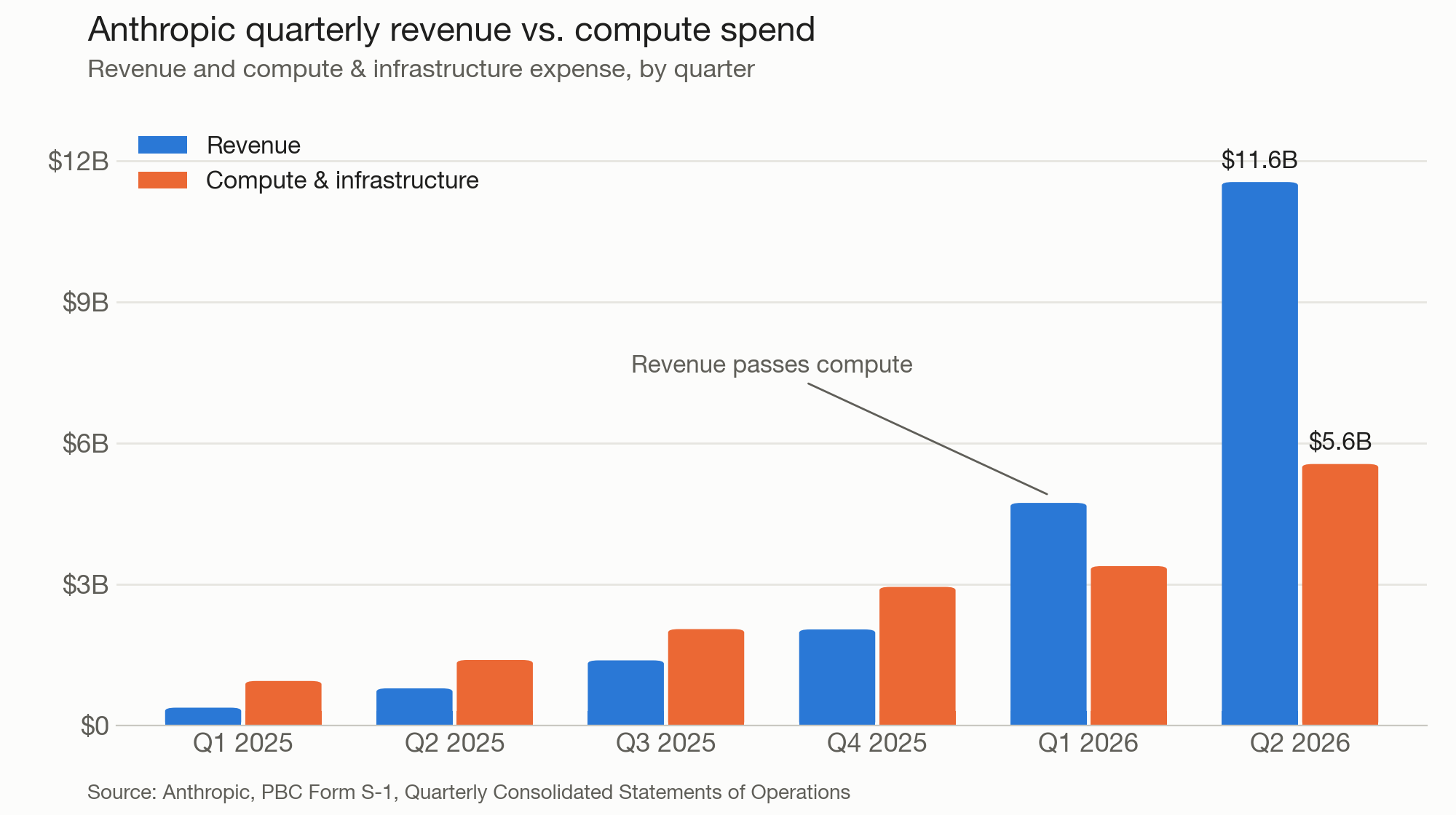
Our compute efficiency is demonstrated by revenue that grew 1,368% year over year for the three months ended June 30, 2026 compared to compute and infrastructure expenses that grew 300% during the same period.
Until 2026, compute cost them more than they brought in. That flipped in Q1, and by Q2 revenue was twice the compute bill. Compute only, not total expenses.
They also had $131.7B in cash, cash equivalents, and short-term investments as of June 30. So they are not running out of money any time soon.
It’s getting cheaper per task
For example, Claude Opus 5.5 reduced customer costs per task by approximately 40% compared to Claude Opus 5.
That lines up with my own experience. Right now Claude is winning on price for me, by far. Personally, my $20-a-month plan is almost always enough, unless I am working on a big project.
One caveat: the 40% is Anthropic’s own number, not an independent benchmark.
Claude Code is the business
In the filing’s words, Claude Code is the product they believe “most concretely defined” what autonomous AI work looks like.
The value that Claude delivers to customers has helped drive our Net Revenue Retention of approximately 900% as of September 30, 2026.
Top Claude Code users spend ~20x more: Enterprise users without it averaged under $75/month. The top 5% who use it spent about 20x that.
For example, in the three months ended September 30, 2026, Claude Enterprise users who did not use Claude Code spent less than $75 per month on average, while the top 5% of Claude Enterprise users who used Claude Code spent approximately 20 times that amount.
This makes sense. I’ve tried using Claude Code with my private API key before. Even simple tasks were burning through tokens (dollars) like crazy. The more people use Claude Code, the more tokens get used. Claude Code is worth it, but the point stands.
As of September 30, 2026, adoption of Claude Cowork, which we made available as a research preview in January 2026, outpaced the adoption Claude Code achieved at the equivalent point following its research preview release in February 2025.
They use it themselves:
Over 90% of the contributions to our codebase in September 2026 were written by Claude.
Our operating efficiency is demonstrated by TTM revenue per employee of over $6.6 million as of September 30, 2026, compared to $1.4 million as of September 30, 2025.
TTM = trailing twelve months.
The coding agent isn’t a side quest. It’s where the money is coming from, and they run their own company on it. We should see continued investment in Claude Code.
They told the Pentagon no
February 2026:
For example, in February 2026, in response to our publicly stated position that our technology should not be used for mass domestic surveillance or fully autonomous weapons, the President of the United States stated that he had directed that all federal executive agencies cease using our technology.
At the same time, the Secretary of War directed the Department of War to designate us as a “supply-chain risk to national security” and stated that “effective immediately, no contractor, supplier, or partner that does business with the United States military may conduct any commercial activity” with us.
August 2026, district court:
The court ruled that the Challenged Actions were retaliatory acts meant to punish us for speech protected under the First Amendment to the United States Constitution and violated our rights under the Due Process Clause of the Fifth Amendment to the United States Constitution.
September 2026, D.C. Circuit (separate case):
On September 25, 2026, in a 2-1 split decision, the D.C. Circuit Court of Appeals denied our petition for review, ruling that the Department of War’s Section 4713 supply-chain risk designation was proper, and that our rights under the First Amendment and Due Process Clause of the Fifth Amendment were not violated.
They held their line against the US government, and it cost them. The case isn’t over. This is especially relevant for anybody doing business with the federal government.
Who’s in charge
There are five share classes:
- Class A (what you can buy): 1 vote per share.
- Class T: one share, held by the Long-Term Benefit Trust, a group of five financially disinterested trustees. It elects a majority of the board.
- Class F: one share, held by an LLC of the seven co-founders. It carries 50.1% of the stockholder vote, including electing the rest of the board.
- Class N (mostly strategic partners): no vote.
- Class E (employees): votes only on a few limited matters.
Our Class F common stock will be entitled to an aggregate number of votes that equals 50.1% of the total voting power of our outstanding shares of capital stock with respect to matters submitted to stockholders generally, including the election of our directors other than the Class T directors.
Our capital stock structure features certain provisions that are novel or otherwise not common among other corporations with multiple-class structures, and may effectively eliminate the ability of holders of our Class A common stock to influence important decisions, including a change in control.
- Pro
- Less quarterly pressure to squeeze prices.
- Con
- Public shareholders can’t vote out the leadership.
What can change
We have also changed, and may in the future change, usage limits, rate limits, or model and product capabilities, which could adversely affect our reputation and the perceived value of our offerings.
In addition, considerations relating to model safety, interpretability, alignment, and welfare may lead us to limit or delay the deprecation of older models or to continue supporting legacy versions alongside newer releases, creating trade-offs in product development and compute distribution that could adversely affect innovation velocity, infrastructure utilization, and revenue.
For example, in June 2026, the U.S. Department of Commerce imposed worldwide export restrictions on our Fable 5 and Mythos 5 models, which we disabled for all customers until those restrictions were lifted.
None of this is unusual or alarming. Plan for limits, models, and availability to change in the future.
Also in the filing
Customer concentration:
While no single customer represented more than 10% of our revenue for the nine months ended September 30, 2026, our top five customers represented approximately 25% of our revenue for the nine months ended September 30, 2026.
People copying Claude:
In addition, competitors, customers, or other third parties have attempted in the past and will likely continue to attempt to replicate, distill, extract, or otherwise derive the functionality or capabilities of our models through permitted or impermissible means, including through our research previews.
Copyright:
The application of certain copyright law doctrines and contractual interpretations of open-source licenses to modern AI model training has not been authoritatively resolved by U.S. and non-U.S. courts as of this date.
These are mostly investor risks.
Conclusion
Anthropic is looking healthy. An incredible success story so far.
That being said, don’t let one vendor be the only way your team ships. Keep skills, docs, etc. vendor-neutral. Opus 5.5 is my daily driver, but I think it’s important to keep up to date with the alternatives.